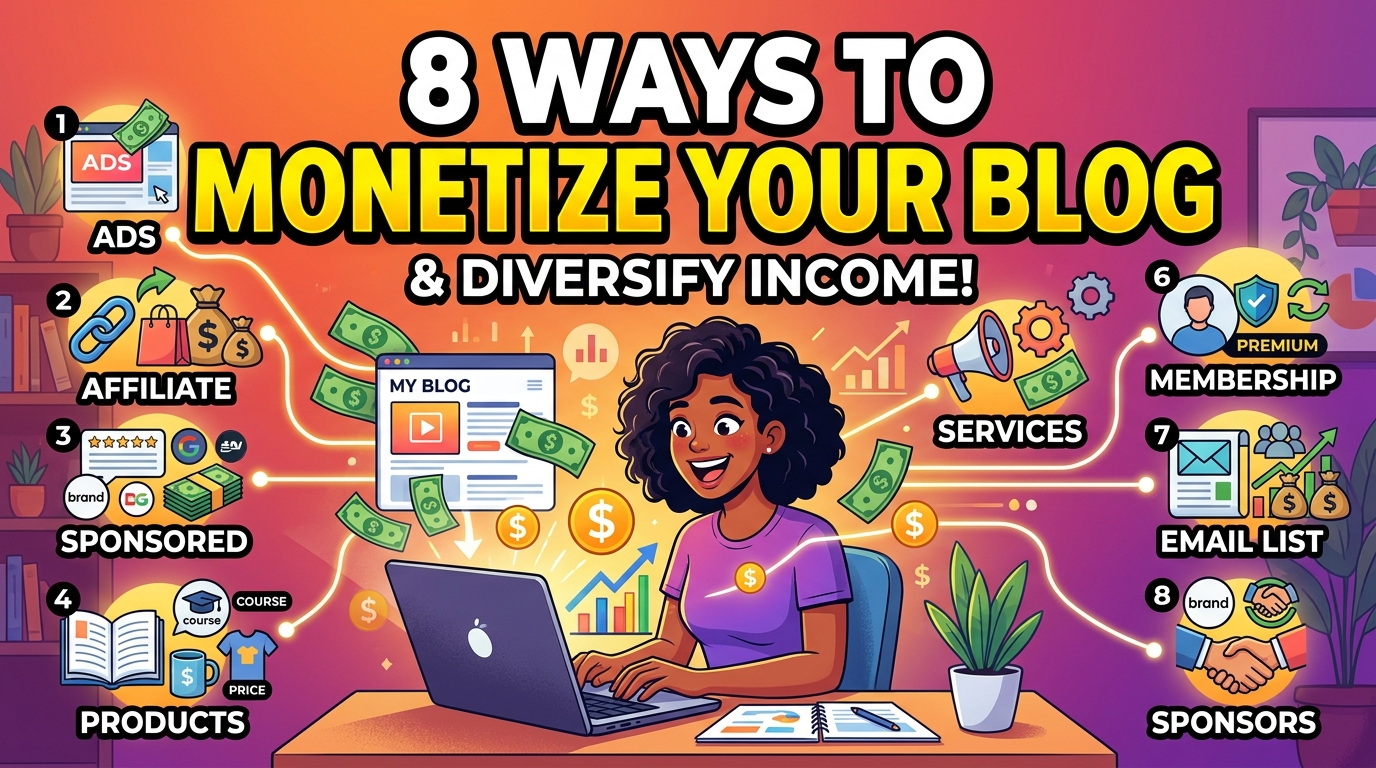
Starting a blog can be an exciting way to share your knowledge, help people solve problems, and build an online business. But one of the biggest questions new bloggers ask is simple: How do you actually make money from a blog?
The good news is that you don't have to rely on just one income source. A blog can generate revenue through advertising, affiliate marketing, digital products, online courses, sponsored content, social media, physical products, and services.
In this article, we'll explore eight ways to monetize your blog, how each method works, and how you can start using them to build a sustainable online business.
1. Make Money With Display Advertising
Display advertising is one of the most common ways bloggers earn money. If you've ever visited a website and seen advertisements between paragraphs, in the sidebar, or at the bottom of an article, you've already seen how it works.
Bloggers partner with advertising networks that display ads to their visitors. Depending on the network and its payment model, you may earn money based on impressions, clicks, or other qualifying activity.
One beginner-friendly option is Google AdSense. After applying and getting approved, you can place advertisements on your website and earn revenue as your content attracts visitors.
As your blog grows, you can explore other advertising networks, including Mediavine. Each network has its own eligibility criteria, so check the current requirements before applying.
Advertising income depends on several factors, including your audience's location, your blog's topic, the number of page views, and advertiser demand.
For example, a blog receiving 50,000 monthly page views may earn a very different amount from another website with the same traffic. There is no universal rate that guarantees a particular income.
How to get started:
- Publish useful articles that answer questions people are searching for.
- Improve your website's speed, navigation, and reading experience.
- Promote your content through channels such as Pinterest.
- Focus on attracting consistent, relevant traffic rather than relying on one viral article.
- Review your analytics to identify content that attracts returning visitors.
Advertising is a useful starting point, but don't assume it will immediately replace a full-time income. Your first goal should be building a website that people genuinely want to visit.
2. Earn Affiliate Income by Recommending Products
Affiliate marketing allows you to earn commissions when readers purchase products or complete other qualifying actions through your referral links.
Imagine you run a home organization blog. You publish an article about organizing a small bedroom and recommend storage bins, drawer dividers, and closet organizers.
When a reader clicks one of your affiliate links and makes an eligible purchase, you may earn a commission.
One popular option is Amazon Associates. Other affiliate opportunities include LTK and Skimlinks, depending on your niche and eligibility.
The major advantage of affiliate marketing is that you don't have to create, store, or ship the products yourself.
However, commission rates differ between programs and product categories. They can also change, which is why it is risky to depend entirely on one affiliate partner.
The podcast highlights an important lesson: recommend products because they genuinely help your readers, not simply because they pay a commission.
Readers can lose trust when every recommendation feels like a sales pitch.
To get started, choose products that fit your audience, create helpful comparisons or tutorials, and explain the advantages and disadvantages of the products you recommend. Disclose your affiliate relationships clearly.
3. Create and Sell Digital Products
Digital products are another attractive way to monetize a blog because you can create something once and sell copies online without shipping a physical item for every order.
Examples include:
- Ebooks and downloadable guides
- Printable planners and checklists
- Budgeting spreadsheets
- Digital planners for tablets
- Website templates and design resources
- Lightroom presets and other creative resources
Suppose you run a personal finance blog. You could create a monthly budgeting spreadsheet that helps readers organize their income, expenses, savings, and debt payments.
Rather than earning a small commission by recommending someone else's budgeting tool, you could sell your own spreadsheet directly.
Digital products can offer attractive profit margins because there is no physical inventory to maintain. However, they still involve costs such as creation time, marketing, payment processing, customer support, and occasional updates.
Your product should solve a specific problem that your readers already have.
For instance, a food blog might sell weekly meal-planning templates, while a travel blog could offer destination itineraries or packing checklists.
Start with a simple product rather than spending months creating a large collection. Publish useful free content, learn what your audience needs, and develop a paid product that provides a more complete solution.
4. Turn Your Knowledge Into an Online Course
If you've developed expertise in a particular subject, an online course can become another income stream for your blog.
Bloggers often build experience through publishing articles, experimenting with different strategies, and helping readers solve problems. Eventually, they may discover that people are willing to pay for a structured learning experience.
For example, a blogger who has developed effective Pinterest marketing strategies might create a course teaching beginners how to design pins, plan content, and analyze performance.
A cooking blogger could offer a beginner's cooking course, while a freelance designer might teach website design fundamentals.
Platforms such as Teachable provide tools for creating and selling online courses.
The key is to identify a genuine need. Don't create a course simply because other bloggers are selling courses. Find a problem your audience repeatedly asks about and build a learning experience that addresses it.
A useful course should have clear learning objectives, organized lessons, practical examples, and actionable exercises.
You should also avoid promising students guaranteed financial results. Your responsibility is to provide useful instruction, not to guarantee what every student will achieve.
Although creating a course requires upfront work, you can sell access repeatedly and update the material as your subject changes. That makes it a potential source of recurring sales, rather than truly effortless passive income.
5. Earn Money Through Sponsored Blog Posts
Sponsored posts are articles or other content that a company pays you to publish or create to promote its products, services, or brand.
Businesses work with bloggers because established websites can reach audiences interested in particular topics.
For example, a home decor company might sponsor a post on a home improvement blog. A software company could pay a technology blogger to explain how its tool works.
You don't necessarily need millions of monthly visitors to attract sponsorships. A smaller blog with a focused, engaged audience may be valuable to a company trying to reach a specific group of people.
To prepare for sponsorship opportunities, create a media kit that explains:
- Your blog's topic and target audience
- Monthly traffic and relevant audience statistics
- Your most popular articles
- Available sponsorship packages
- Your contact information and collaboration terms
Set prices based on the work involved, your audience, your reach, and the value you provide. Be prepared to discuss deliverables, deadlines, usage rights, and whether the company can reuse your content in advertisements.
Most importantly, protect your readers' trust. Only accept sponsorships that fit your website and audience, and clearly disclose paid relationships.
The U.S. Federal Trade Commission provides guidance on disclosures for social media influencers and other online endorsements.
6. Use Social Media to Build Additional Income
Your blog doesn't have to be the only place where you publish content or earn money.
Social media platforms can help you reach new audiences, promote your articles, and develop additional revenue opportunities.
For example, you could turn a blog post into a short video, create a series of tips for TikTok, share visual summaries on Pinterest, or publish longer educational videos on YouTube.
Depending on the platform, your eligibility, and the programs available in your country, you may be able to earn through advertising revenue, creator monetization programs, affiliate partnerships, sponsorships, or product sales.
Explore the official platforms here:
Remember that direct platform payouts are not guaranteed. Monetization rules, audience thresholds, and country eligibility can change.
Social media can still be valuable even when it doesn't pay you directly. A helpful video might send someone to your website, where they read your article, join your email list, or purchase a digital product.
Instead of trying to master every platform immediately, choose one or two that fit your content and audience.
7. Sell Your Own Physical Products
Once your blog has an audience, you may decide to create and sell physical products.
This approach gives you more control over your products, pricing, branding, and customer experience than simply promoting products through affiliate links.
For example, a productivity blogger could sell printed planners. A fitness blogger might develop workout journals, while a home decor blogger could sell carefully selected accessories.
Physical products can generate revenue, but they also require more operational work.
You may need to manage manufacturing, inventory, packaging, shipping, customer service, damaged deliveries, refunds, and taxes. These responsibilities become more complicated as sales increase.
Before launching, research your audience's needs and calculate your costs carefully.
Consider starting with a small product range or a limited test before investing heavily in inventory. Your blog can help you understand what readers want by collecting feedback and studying which topics attract the most interest.
The goal is to create products that solve real problems, not simply products that you hope people will buy.
8. Use Your Blog to Sell Services
A blog can also serve as a marketing tool for a service-based business.
Instead of earning only when someone clicks an advertisement or buys a product, you can use your articles to demonstrate your expertise and attract paying clients.
Examples include:
- Freelance writing and editing
- Website design and development
- Virtual assistance
- Consulting and coaching
- Photography and graphic design
- Cleaning and home organization
- Pet sitting and other local services
Imagine that you run a cleaning blog. You publish articles explaining how to remove common stains, organize a home, and maintain different surfaces.
Readers begin to recognize your knowledge and may contact you when they need professional cleaning services.
The same principle applies to web designers, financial coaches, photographers, and other service providers.
Your content helps establish credibility before a potential customer contacts you.
To make this strategy work, explain what you offer, who you help, and how people can contact you. Include relevant examples of your work, testimonials when available, and a clear description of your services.
You can start with a small number of clients and expand as demand grows. Unlike physical products, many services don't require inventory, although you still need to account for your time, tools, operating expenses, and other costs.
How to Choose the Best Monetization Strategy for Your Blog
With eight different options available, it can be tempting to try everything at once. However, each income stream requires different skills, systems, and resources.
A more practical approach is to build gradually.
If you're a beginner: Focus on publishing useful content, learning how to attract visitors, and exploring suitable advertising or affiliate opportunities.
If you already receive regular traffic: Improve your affiliate content, experiment with relevant advertising networks, and consider developing a simple digital product.
If readers regularly ask you for advice: Explore creating a course, offering a service, or developing a paid resource that solves a recurring problem.
If you have an established audience: Consider sponsorships, your own products, and additional distribution channels.
You should also monitor your results. Track where your revenue comes from, which articles attract valuable visitors, and how much time each income stream requires.
Most importantly, diversify. Affiliate commission changes, advertising performance fluctuates, and social platforms can change their rules. Having several complementary revenue sources can reduce your dependence on any single company.
Final Thoughts
Making money from a blog is not limited to displaying advertisements. Your website can become the foundation of a business that earns through affiliate marketing, digital products, online courses, sponsorships, social media, physical products, and services.
You don't need to launch all eight methods immediately. Start with one or two that match your skills and your audience's needs, then expand as your website grows.
The most important lesson is to build something readers find genuinely useful. When your content helps people solve problems, discover products, or learn new skills, you create opportunities to earn revenue while delivering real value.
A successful blog is more than a collection of articles. With patience, consistent effort, and a thoughtful monetization strategy, it can grow into a business with multiple sources of income.


0 Comments
Leave a comment